
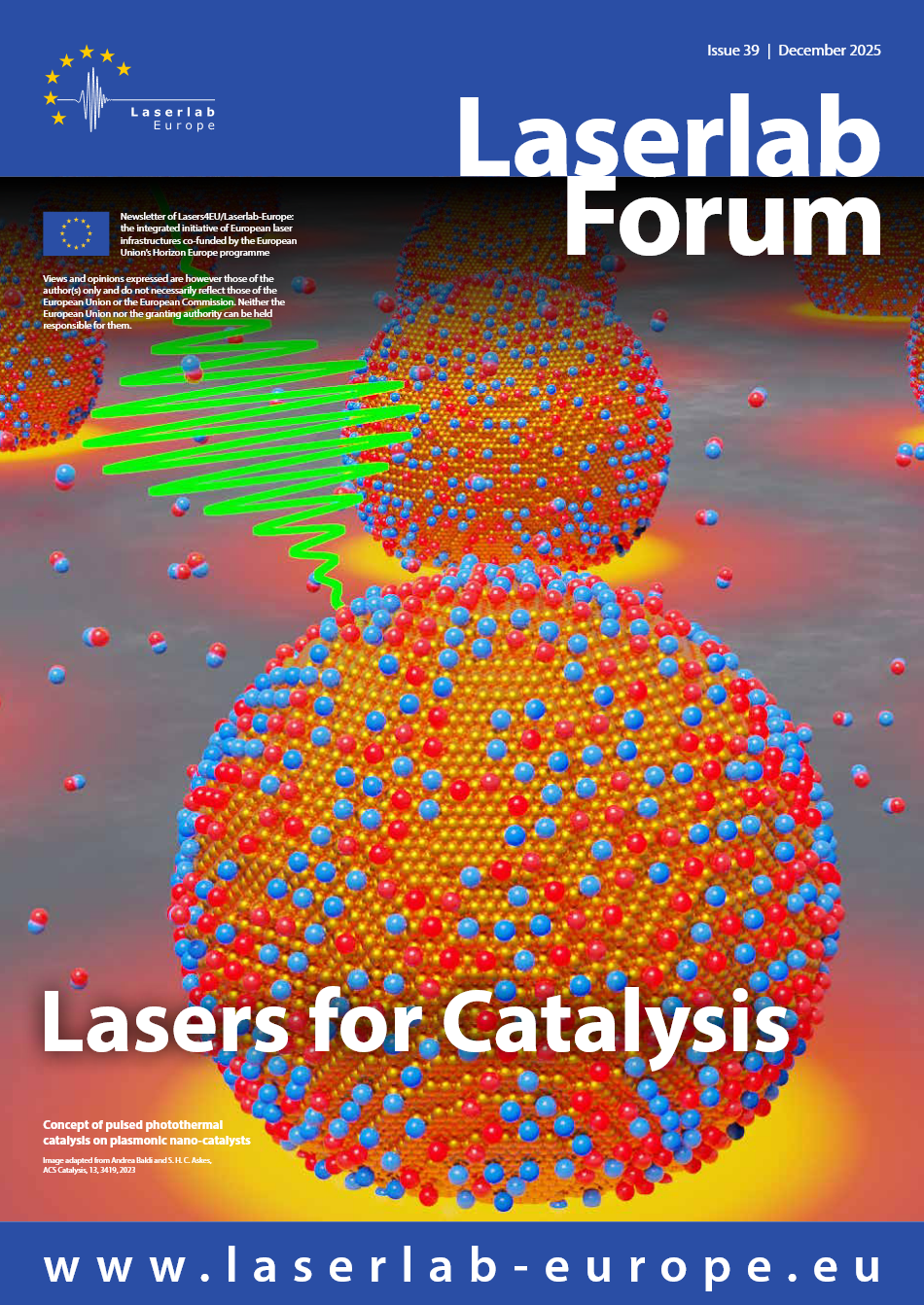
Focus: Lasers for Catalysis
Catalysis is key to many things we rely on, from clean energy to industrial and environmental
processes. To reveal how catalysts work and make them better, scientists must explore atomic-scale
interactions and reactions that occur either extremely quickly or under demanding conditions. Lasers
have become essential tools for meeting these challenges, providing the accuracy needed for this
work. This issue of Laserlab Forum presents new advances from Laserlab-Europe and Lasers4EU.
- Laser light reveals the secrets of catalysis (LLC, Sweden)
- Photocatalytic CO₂ reduction probed by time-resolved infrared-spectro-electrochemistry for a mechanistic insight of the steps leading to the active catalyst (CLF, United Kingdom)
- New catalyst unveils the hidden power of water for green hydrogen generation (ICFO, Spain)
- Dynamic catalysis: a new playground for laser science (LaserLaB Amsterdam, The Netherlands)
- The development of advanced IR techniques for catalysis studies at the CLF (CLF, United Kingdom)
- PLANKT-ON: Advancing artificial photosynthesis for net-zero energy conversion (POLIMI, Italy)
News
- Sweden’s most powerful laser delivers record-short light pulses
- Quantum correlation revealed by attosecond delay
- Laserlab Spain newly founded
- ELI’s L4 ATON laser achieves 5 petawatt
- New technique combining imaging and spectroscopy for metabolic disease research using infrared free-electron laser
- Three ERC Synergy Grants for projects involving Laserlab-Europe scientists
Access highlight
Tailoring optical anisotropy of materials through femtosecond laser excitation
Gallium sulphide (GaS) is a monochalcogenide material that has attracted particular attention in optical
technology development, due to the ability to tune its bandgap for UV-light detection applications. In situ,
in operando X-ray diffraction analysis has been used to investigate local atomic changes induced in GaS by
femtosecond laser pulses, and evidence elongation of the unit cell along its c-axis. Ab initio calculations have
been used to support the findings. The light-induced structural changes are expected to enhance the anisotropy
of GaS’s physical properties and deliver optical properties of interest for reconfigurable photonics applications.
ERC Grants
Congratulations to the six scientists who were recently awarded ERC grants, five receiving a Starting Grant, and one receiving a Consolidator Grant:
- Rahul Trivedi (MPQ)
- Vincent Wanie (DESY)
- Nicoletta Liguori (ICFO)
- Carmen Rubio-Verdú (ICFO)
- Laura Dreissen (LLAMS)
- Dierck Hillmann (LLAMS)
Community news
- Lasers4EU launches multi-instrument access route
- Lasers4EU Access Search Tool: Explore access opportunities across our facilities
- Laserlab-Europe and Lasers4EU Annual Meeting
- Successful RIANA Laserlab-Europe & RADIATE users’ meeting