
How to access
1. Choose your access route
Lasers4EU offers three routes to transnational access:
For users seeking a suitable laser facility for a single-access project, in any research field, from fundamental science to validation of an application concept.
Single proposal for multi-facility access and/or repeated experiments within one project, potentially over several years.
Important: Not all partner laboratories participate.
Allows companies to access the most recent laser-based techniques and methods, supported by the expertise and services of Lasers4EU partner facilities.
2. Check your eligibility
To be eligible, the majority of users must work in a country different from the country(ies) in which the host infrastructure (whether a single facility or a suite of facilities) is located, except when access is provided by an international organisation, a Joint Research Centre (JRC), an ERIC, or a similar legal entity.
Access by users from third countries is welcome.
3. Find a lab
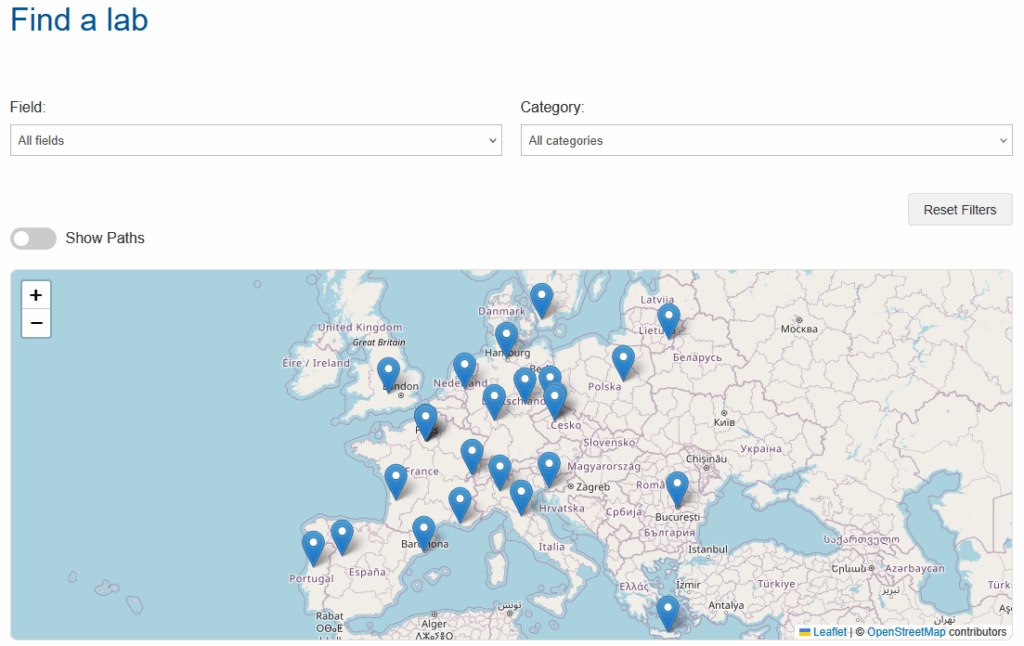
To find a suitable laboratory for your access project, visit our find a lab page.
Interested researchers are encouraged to contact the Director(s) of the laboratory(ies) they wish to visit to obtain information on detailed access opportunities and conditions.
5. Evaluation of your proposal
1. The selected host infrastructure will check whether the submitted proposal meets all criteria of eligibility of the Lasers4EU transnational access programme, evaluate its feasibility and forward it to the Access Selection Panel (ASP). In the case of the multi-instrument route, all the requested facilities must declare the proposal feasible.
2. ASP will check the proposal and forward it to selected external reviewers who are responsible for the scientific evaluation of the proposal. The reviews are sent to the ASP.
3. ASP analyses the reviews and makes a final decision based on:
– Scientific merit
– Length of the access visit(s) (adequacy of the duration of the project to the work plan).
Priority will be given to short-duration projects and to user groups who have not previously visited the API and who would not normally have access to it.
4. Applicants will be notified of the outcome via the ARIA Portal.
Explanatory Note:
While both the consortium and the external Selection Panel strive to keep the evaluation and selection period as short as possible, applicants should anticipate a typical processing time of four to eight weeks. In exceptional cases—such as delays in securing external reviewers—this period may be extended.
Please note that access visits may only commence following formal approval by the Selection Panel.
6. Access and follow-up
Upon approval, users are required to start planning their visit. This includes contacting the host infrastructure to agree on suitable dates and gathering all necessary information regarding administrative procedures. Travel and accommodation costs are covered in line with the usual practices of the hosting institution(s).
In the case of the multi-instrument route, the sequence of visits must be planned during the preparatory phase. However, after each visit, a brief report must be submitted to the next host facility, which may decide to adjust the schedule or cancel the visit depending on the results obtained.
During the visit, guest scientists must complete and sign an attendance sheet for each day spent working in the lab.
At the end of the experiment(s), users have to submit a brief project summary report and complete a questionnaire in the ARIA portal (one per proposal).
Validity period & extensions
Once accepted by the Selection Panel, the experiment must be scheduled and completed within a 20-month validity period. If it has not at least started within that time, resubmission is mandatory.
If extra time is needed, an extension may be requested (up to 3 days decided by the Access Board, up to 5 days with advice from the Selection Panel chair). Longer extensions require a new application.